

Andrea Palladio / Villa Rotunda (1571 Vicenza, Italy)
Classical Architecture is defined as designs derived from the Greeks and Romans during the Classical Era (8th century BC to 5th Century AD). Other than the ancient buildings that still exist, the underlying philosophy that guided these buildings comes to us largely through the written treatise, De Architectura, written by the ancient Roman theorist Vitruvius. This work was largely promoted by the 16th century Italian architect Andrea Palladio, who illustrated Vitruvius’s long-lost theories, both in his architecture and in his famous four-volume treatise, I Quattro Libri Dell’Architettura (The Four Books of Architecture), which he wrote and published. Our modern understanding of Classical Architecture and all the Classical Revival designs (which are based on these historical precedents) largely rests on the philosophy and writings of these two men born 1500 years apart from one another.

Palladio Elevation Architectural Drawing
From Palladio’s work and writing, generations of European architects in the 17th and 18th centuries, particularly such giants as Bernini in Italy, and Christopher Wren and Inigo Jones in England. Widely distributed across Europe, this book became the essential pattern manual for the Neo-Palladian style that dominated 18th-century English architecture and subsequently crossed the Atlantic to the British colonies.

Redwood Library / Peter Harrison (1742 Newport, RI)
In the nascent United States, this classically-derived style was deliberately chosen to represent the new Republic’s ideals of democracy, reason, and order, linking it directly to the two ancient democratic republics. Thomas Jefferson was the Classical style’s most zealous and noteworthy champion in America, and he famously called Palladio’s writings “His Bible.” His designs for Monticello and the University of Virginia are prime examples of Palladianism shaping the architecture of the early Unites States.

Redwood Library and Athenaeum Plan with Additions / Peter Harrison (1747-1750)
While Jefferson cemented the style nationally, the thriving Colonial Era seaport of Newport, Rhode Island, was also a crucial early incubator for American Palladianism. The architect credited with introducing the style to the colonies was the English-born Peter Harrison (1716-1775).

Redwood Library (Peter Harrison & others)
Harrison’s most significant contribution is the Redwood Library and Athenaeum (1747-1750). The structure, with its central pedimented Roman Doric portico and flanking wings, is a classic interpretation of a Roman temple model, directly inspired by a plate from an English edition of Palladio’s work. Its adaptation used local wood meticulously treated with “rustication” to imitate the look of stone, emulating the sophisticated Palladian design, but with locally available materials.

Interior of Touro Synagogue / Peter Harrison (1763 Newport, RI)
Harrison’s other major Newport works further showcased this nascent classicism. The Touro Synagogue (1759-1763) features an interior of classical columns representing the twelve tribes of Israel, demonstrating the application of classical orders to religious structures. In The Brick Market (1761-1772) incorporated Palladian elements like arcades and proportions, filtered through Inigo Jones, to establish a new, grander civic architectural language in Newport’s central Queen Anne Square (later renamed Washington Square upon the passing of the founding President in 1799).
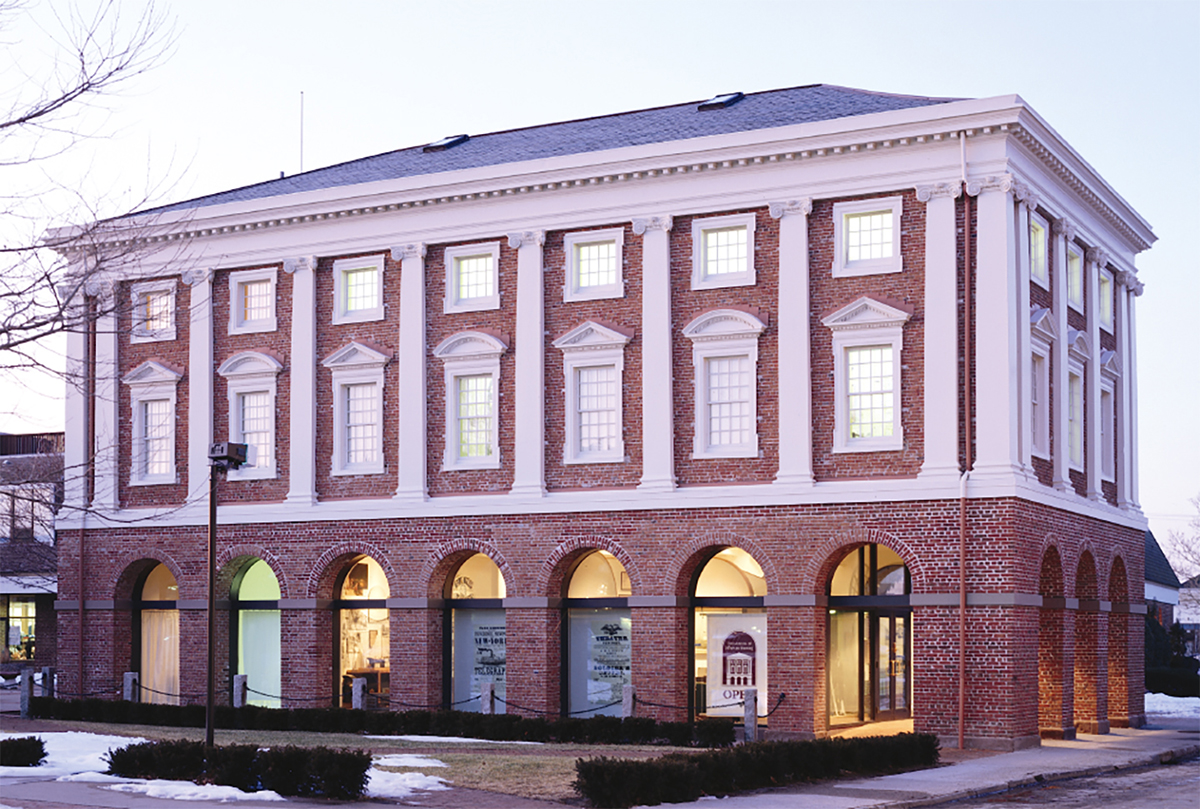
Brick Market / Peter Harrison (1762 Newport, RI)
Newport’s Palladian buildings, particularly the Redwood Library, became models for other classically-inspired structures throughout the colonies, bridging the intellectual world of the Enlightenment with the built environment of the new American identity.
If you would like to have a Classical Revival building located in New England either renovated or designed, A4 Architecture has the knowledge and expertise to assist you. We look forward to being in communication.
Ross Sinclair Cann, RA, AIA, LEED AP, is an author, historian, and practicing architect living and working in Newport, RI. He holds honor degrees in Architectural History and Design from Yale, Cambridge, and Columbia Universities.