
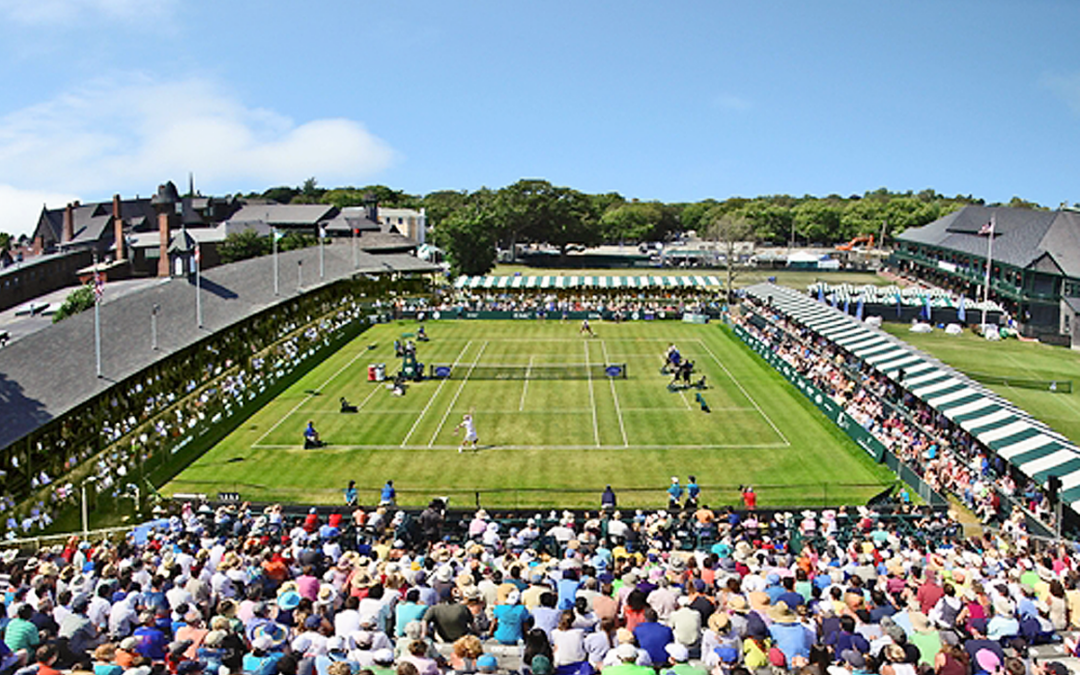
Hall Of Fame Open, Newport Casino
The Newport Casino was one of the first places that lawn tennis was played following the invention of the sport invented and patented by Major Walter Clopton Windale in 1874. The sport took elements of Real Tennis but applied them to the standard lawn croquet courts that existed at many Victorian Era clubs. This converted a serious, elaborate, and expensive sport that was played only at palaces and private clubs and created a game available to a much wider array of players as a light-hearted outdoor diversion.
The Hall of Fame Tournament is the only ATP and WTA competition played on grass in North America and extends the tradition of championship level tennis in Newport. The Newport Casino is where the first American championship was played in Newport, RI in 1881. This really marked the beginning of competitive tennis in the North America. The American championship (which is now called the US Open) was held in Newport from 1881 until 1915, when it was moved to the West Side Tennis Club, to be closer to New York, where the number of spectors was far larger..
This year, the tournament will be played from Sunday, July 5 to Sunday, July 12, 2026. The competition will be a combination of a Men’s Challenger (ATP 125) tournament and a Women’s WTA 125 competition and will have both singles and doubles championships. As was the case in 2025, this year the competition will occur simultaneously with the second week of Wimbledon, and so the Hall of Fame Open will not have players coming directly from that tournament as it had in the past. (More information on the draw and tickets is available at HallOfFameOpen.com.)
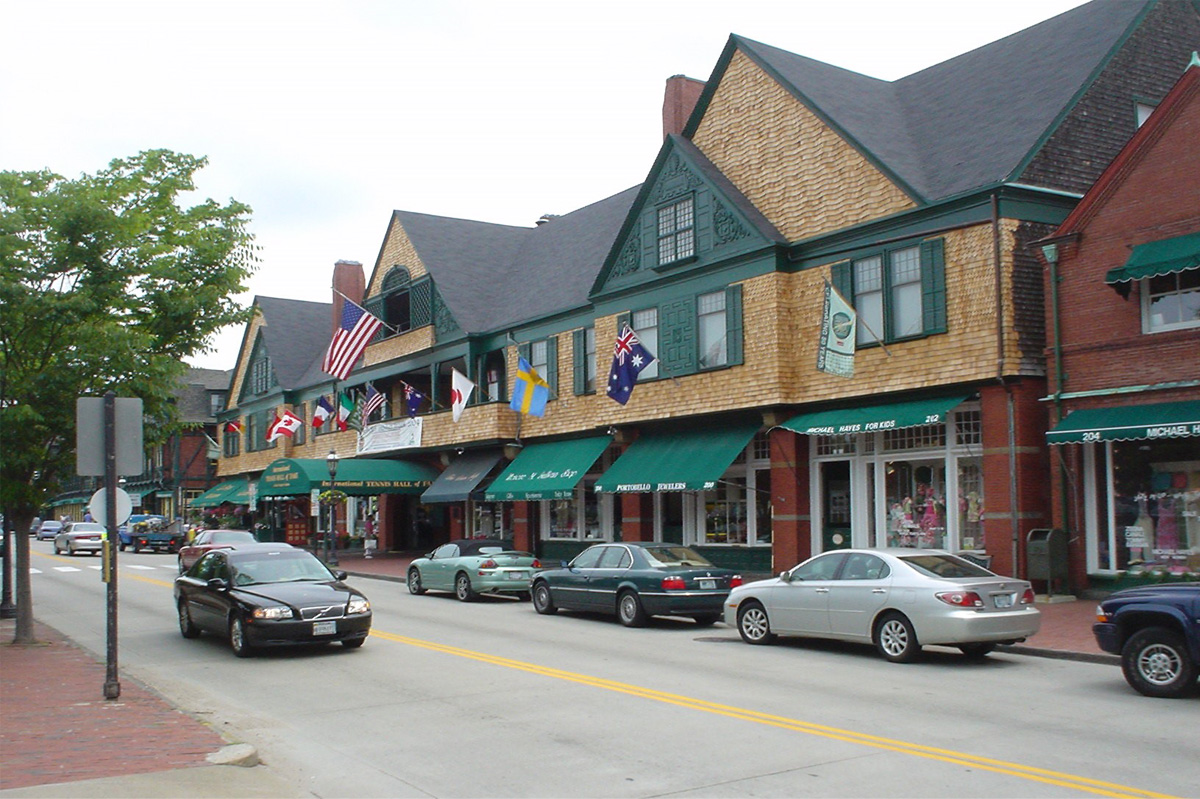
Bellevue Avenue Facade, Newport (1880, Mckim, Mead & White)
When the Newport Casino was first built in 1880, the game of lawn tennis was a new but quickly growing sport. The game had been derived from the more complicated and architecturally involved game now known as Real Tennis, which had been invented in 13th-century France. To make the sport of “tennis” more accessible and affordable to all, Major Walter Wingdale took the essentials of the game of hitting a ball over a net with wooden racquets and was granted a patent for his new variation of the sport by Queen Victoria in 1874.
The Newport Casino was commissioned in 1879 by James Gordon Bennett, who owned an estate once located across the street from the Newport Casino site. He reportedly created the club after the members of the Reading Room Club objected to his polo instructor riding up the staircase to the second floor of the building on a bet. Bennett was the eccentric millionaire publisher of the New York Herald newspaper and was famous for doing exactly as he liked. He reputedly said he created the club so that people could “have a bit of fun,” thus implying such a thing had not actually been possible in Newport previously. After a lightning-fast six-month design process, construction on the Newport Casino broke ground on January 8, 1880. Through the efforts of 200-300 construction laborers, the facility was opened to patrons in July of 1880, barely six months later. The club had both men and women members, which was unusual for its time.
Bennett selected the newly remade firm of McKim Mead & White to undertake the design work. With the addition of Sanford White, the new firm completed the design work for the Newport Casino and began its rapid ascent. The Newport Casino project was widely published as Newport was a place closely followed in both the social and architectural press during that time.
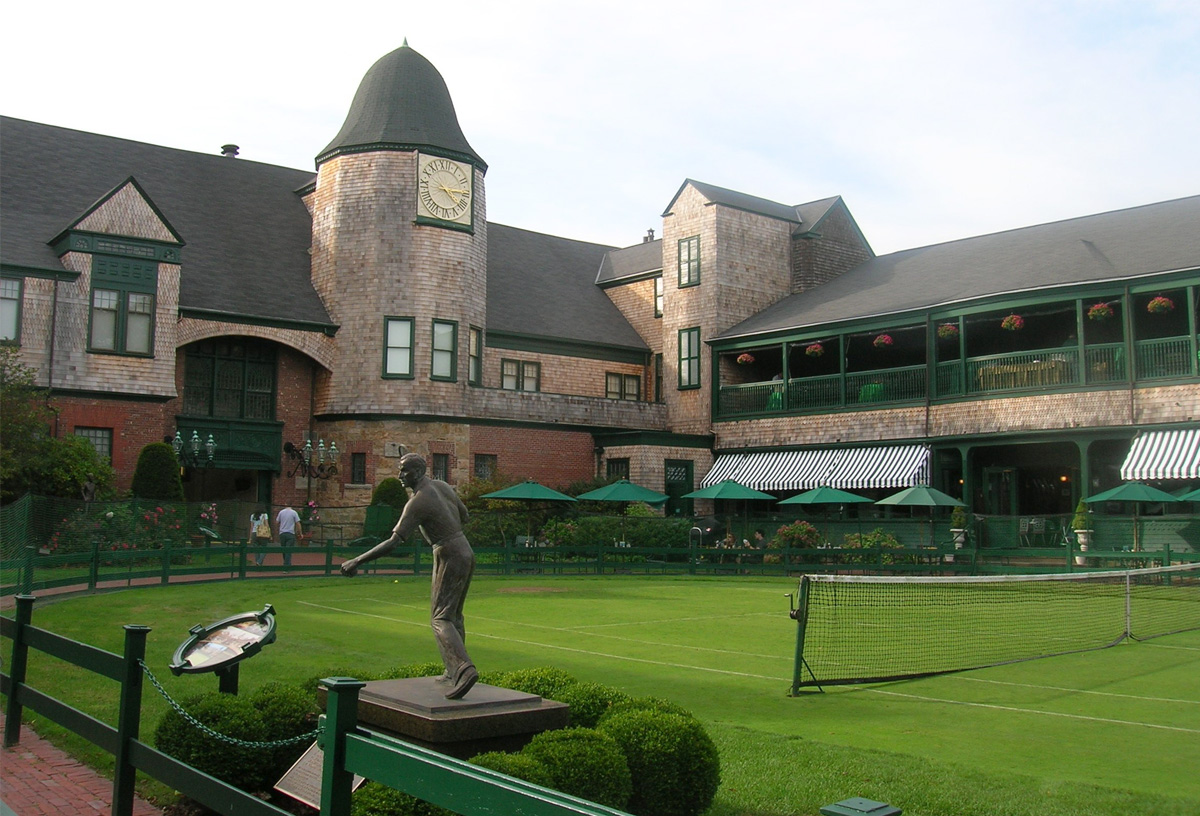
Horseshoe Court
Located at 194 Bellevue Avenue, the Casino building is a masterpiece of the “Shingle Style,” which first evolved during the 1880’s. The Shingle Style was given its name by Yale Architectural Scholar Vincent Scully in his 1955 seminal work The Stick Style and the Shingle Style. As Scully defined it, the style was a refined and simplified version of the earlier Queen Anne Revival formula, which was characterized by more polychromy and half timbering. The Shingle Style used cedar shingles cut in various patterns to create an almost painterly cloak to it asymmetric and free-formed volumes, thus giving it its name naturally and succinctly.
The Casino (meaning “little house” and not “place of gambling” in those days) represented a new sort of leisure facility with dining, sporting and other facilities under one roof—what would later become known as the “country club.” This magnificent complex is intact thanks to the vision (and generosity) of summer Newporters James and Candace Van Alen, who saved the site from becoming a strip shopping center in 1954 by inventing a new use for the facility—the Lawn Tennis Hall of Fame. In 1973, induction into the institution was widened to include international players and in 1976 it was renamed the International Tennis Hall of Fame (ITHF). This grand building complex is now home to one of the central collections of tennis history and memorabilia in the world, including the original patent, signed by Queen Victoria, for the invention of lawn tennis.
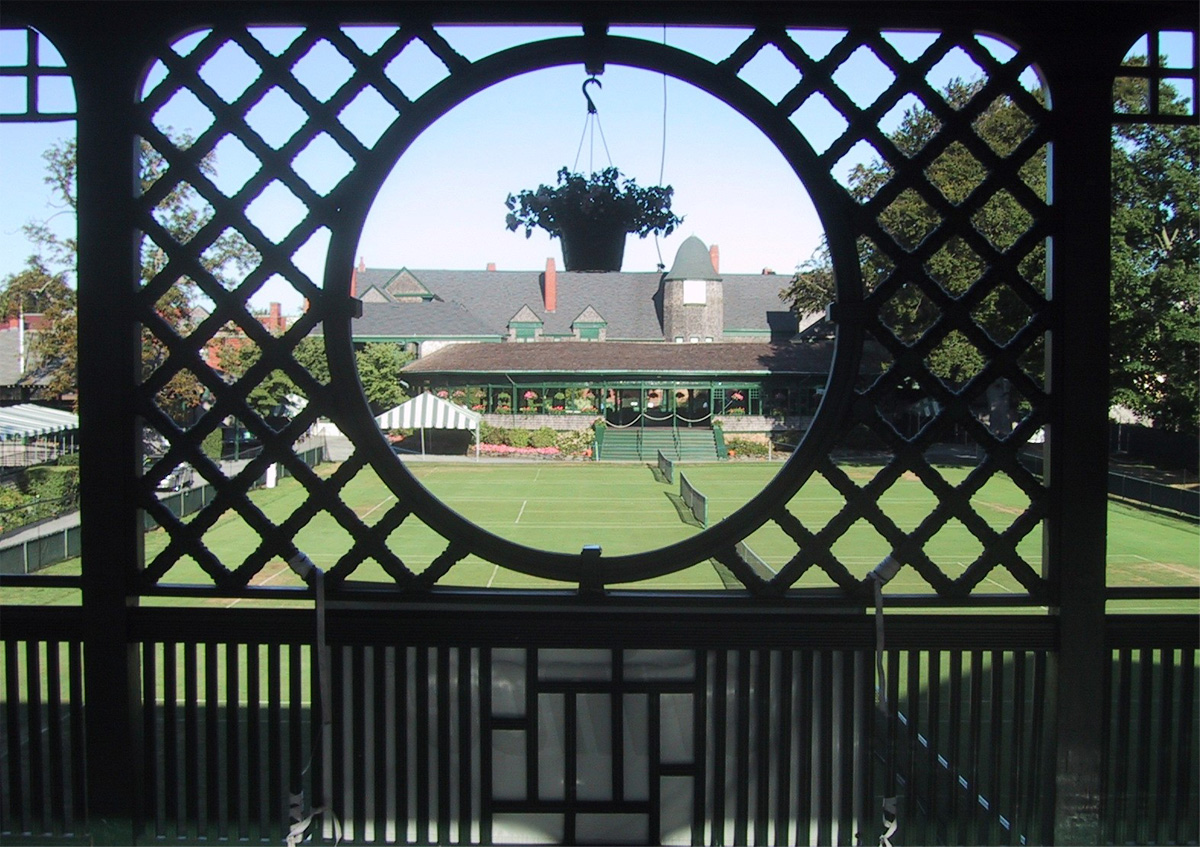
Lawn Tennis Courts from porch, Newport Casino
For its importance in the career of McKim, Mead and White, in the development of the American Shingle Style, and in the evolution of the “Country Club”, the Casino complex was designated a National Historic Landmark in 1987. It is a place which, from its earliest days to the present, has been associated with tennis in America, through the Hall of Fame located there, and with the greatest players from around the world enshrined in this Pantheon of Tennis. This venue deserves a wonderful summer tournament to carry on the great tradition of tennis in Newport and hopefully it will continue to be recognized as the American Temple to Tennis far into the future.
A4 Architecture is proud to have completed five separate projects on the Newport Casino campus. If you have a historical structure in New England that deserves expert architectural attention and design, please reach out to the award-winning team at A4 Architecture, so that we can learn more about your building and project to help guide you in its renovation or restoration. We look forward to being in communication soon.
Ross Sinclair Cann, RA, AIA is a historian, educator, and practicing architect living and working in Newport. He is the Founding Principal of A4 Architecture and the former President of the National Tennis Club located at the Newport Casino. He holds architecture degrees from Yale, Cambridge, and Columbia Universities and is former president of the National Tennis Club located at the Newport Casino and has had a box for the ATP tournament for nearly twenty years.