
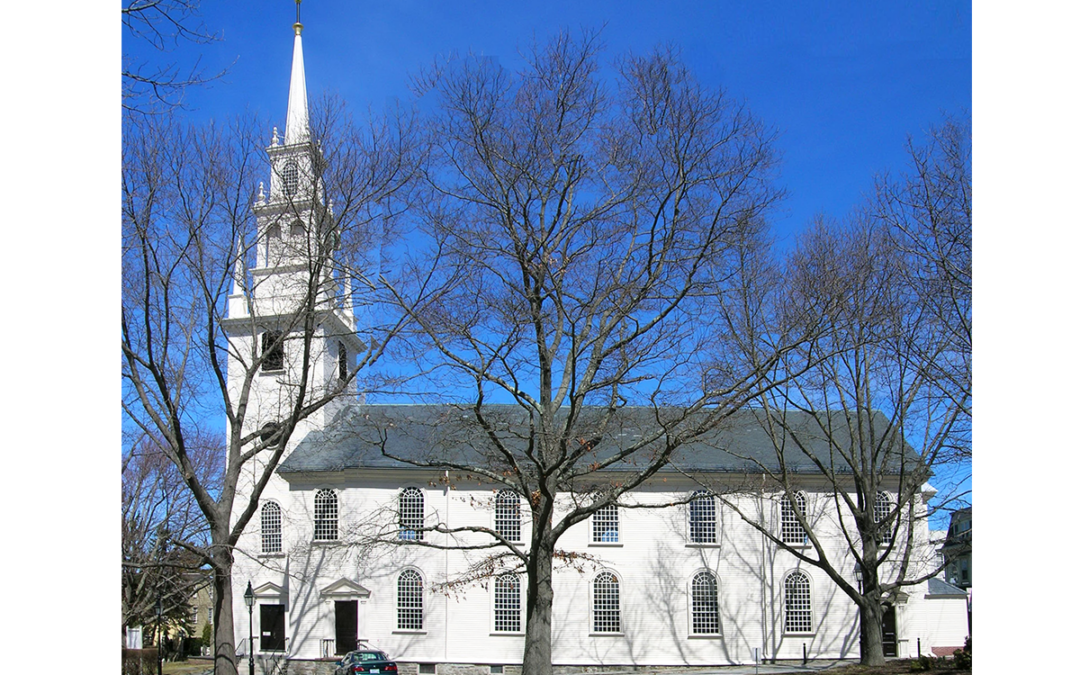
Trinity Church, Newport, 2026
Standing at the heart of Queen Anne Square in Newport, Rhode Island, Trinity Church has watched three centuries of American life unfold around it. On May 31, 2026, Trinity Sunday, the congregation marked a milestone worthy of the whole state’s attention: three hundred years since its beloved Georgian building first opened its doors for worship in 1726. Native Newporter and Rector of Trinity Church, the Reverend Canon Megan Kelly Bowers, welcomed guests and prominent church officials to join in the celebration. The special service was highlighted by the participation of the Most Reverend Sean Rowe, the presiding bishop of the American Episcopal Church, who delivered the sermon on the Mystery of the Trinity, a very appropriate topic for both the day and location of the sermon.
Roots in Rhode Island’s Spirit of Tolerance
Trinity’s story begins long before its famous building was constructed. The parish was founded around 1698, when a group of Anglicans, joined by Quakers and Huguenots, gathered in Newport seeking religious community. Newport was a natural home for them. Following the trail blazed by Roger Williams and Anne Hutchinson, the city had long been a refuge for those fleeing religious intolerance elsewhere in the colonies. Here, the Church of England could take root not through coercion, but through genuine freedom of conscience. Sir Francis Nicholson, a prominent colonial soldier and politician, is credited as the congregation’s original founder. An early wooden church was built around 1700 to serve the growing flock, but it would not last long. The congregation swelled rapidly, and within a generation it had outgrown its modest beginnings.
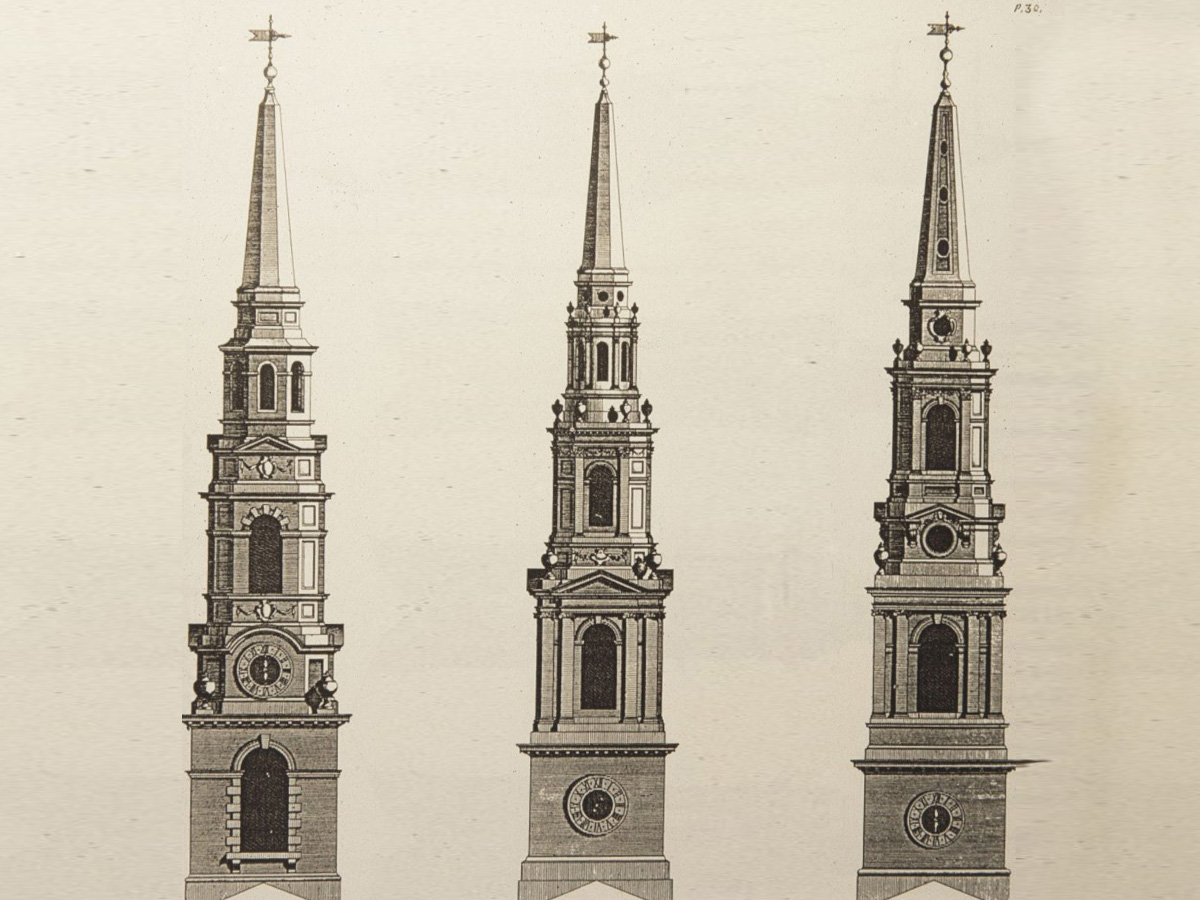
Gibb’s Book of Architecture (Munday’s Probable Inspiration)
Richard Munday’s Masterpiece
In 1724, the congregation commissioned master builder Richard Munday to design a new and grander structure. Munday drew inspiration from the work of the great English architects Christopher Wren and James Gibbs. Munday’s design bears a striking resemblance to Boston’s Christ Church (Old North Church), designed just three years earlier in 1723 by William Price. The key difference is that Trinity Church (Newport) was built entirely of wood, rather than brick or stone, which is a testament to New England craft and pragmatism.
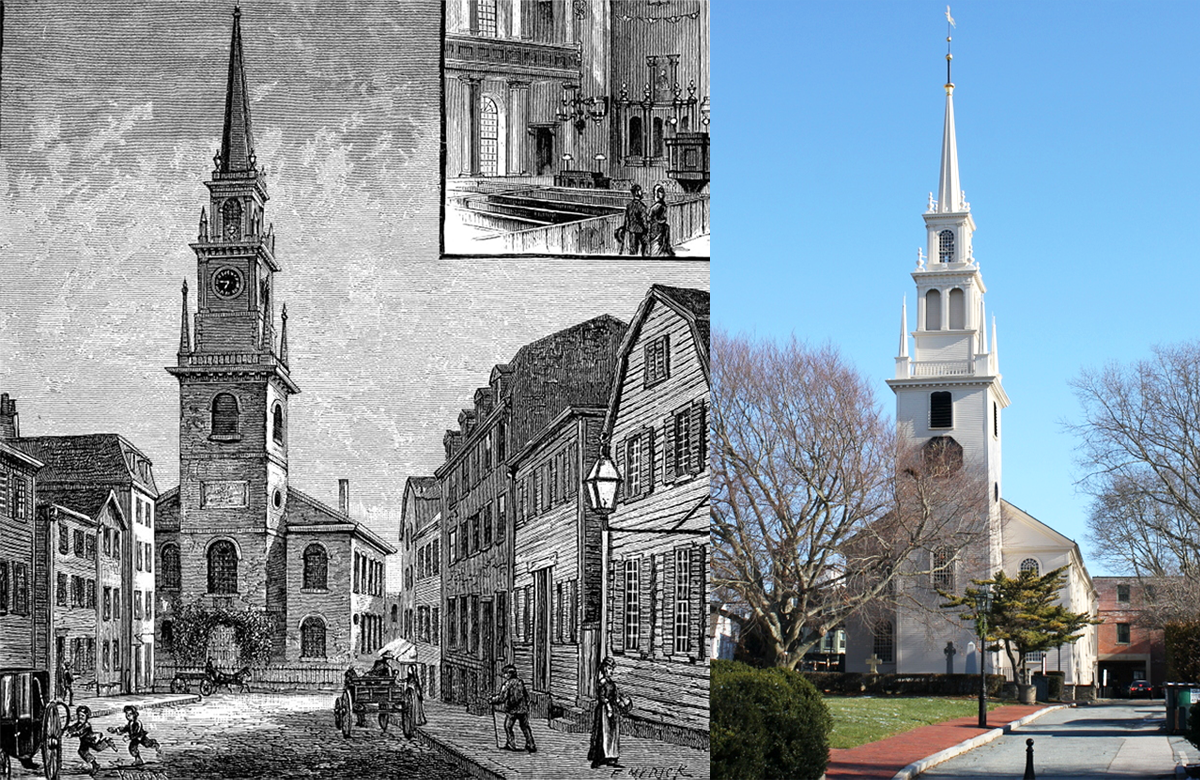
Boston’s Christ Church (William Price, 1723) & Trinity Church (Newport, 2026)
The resulting structure is a triumph of early Georgian architecture. Rectangular in form and clad in clapboard siding, the church is anchored by a prominent steeple that was added to Munday’s original design in 1741 and has since become a prominent part of Newport’s skyline. Inside, Munday created what remains one of the most remarkable liturgical spaces in America: a three-tiered, wineglass-shaped pulpit positioned in the center of the main aisle. It is the only freestanding, center-aisle, triple-decked pulpit surviving in the United States. The church was expanded in 1762 and its steeple rebuilt in 1768, and a sweeping $3 million restoration in the 1980s returned it to its original appearance.
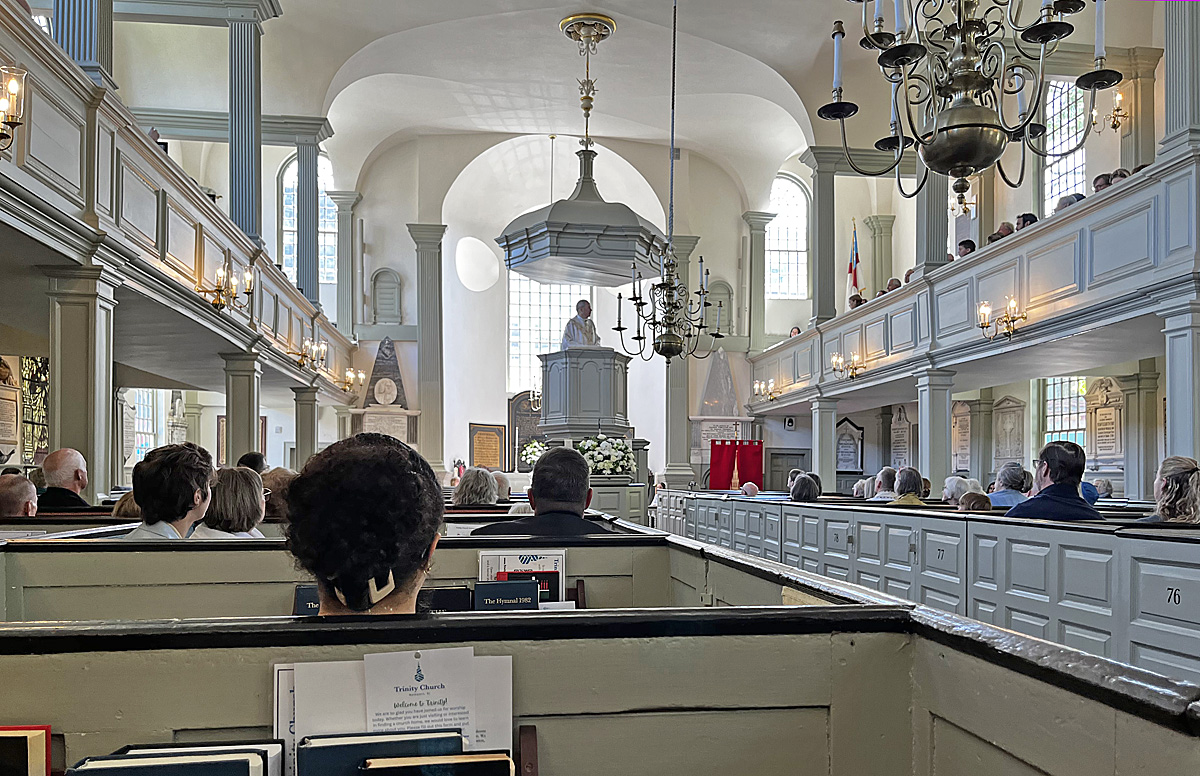
Trinity Church Interior (Newport, 2026)
A Church at the Crossroads of History
Trinity has never been a church apart from the world, but has always been woven into its community. Its organ, legend holds, was tested by the composer George Frideric Handel before being shipped from England, a gift from the philosopher-bishop George Berkeley. Queen Anne herself sent the congregation an altar table and a bell in 1702. By the mid-eighteenth century, Trinity was home to the largest Anglican congregation in all of New England.
When the American Revolution arrived, Newport found itself at the center of conflict. British forces occupied the city from 1776 to 1779, and Trinity, like the city around it, endured. After independence, the nation’s first president, George Washington, worshipped there; his favorite pew, number eighty-one, is still commemorated with a silver plaque. The box pew on the south side of the main aisle bears the names of other distinguished visitors, including Queen Elizabeth II, and Archbishop Desmond Tutu, among others.
The church’s steeple has served practical purposes too. As former naval officer and church historian Dr. John Hattendorf (who also attended the special service) has noted, for centuries it acted as a navigational beacon for sailors approaching Newport Harbor from the sea because of it prominent spire.
A Living Landmark
Trinity was designated a National Historic Landmark in 1968, the same year tobacco heiress and preservationist Doris Duke founded the Newport Restoration Foundation to protect the city’s colonial heritage. Today, Trinity’s Tiffany stained-glass windows glow above an active and growing congregation. The church has even stepped into popular culture, serving as a filming location for Wes Anderson’s Moonrise Kingdom.
A whole program of lectures and events have been planning by congregants Bob Smith and Jeff Clark to celebrate Trinity Church’s 300th anniversary, which can be found at www.TrintyNewport.org. Perhaps the biggest undertaking is the fundraising for the commissioning of a new Tricentennial Organ. Three hundred years on, Trinity Church is not a relic. It is a living presence — a place where Newport’s past and present meet, and where, as Rector Brower put it simply, “Everyone is welcome to worship here.”
If you are undertaking an architectural project in New England that you would like to stand the test of time, feel free to reach out to the award-winning architectural team of A4 Architecture. While it cannot be guaranteed that your structure will last 300 years as well, they will help make sure that your building is beautiful, well-designed and energy efficient.
Ross Sinclair Cann, AIA is an historian, educator and practicing architect living and working in Newport at A4 Architecture. He holds architectural degrees from Yale, Cambridge, and Columbia Universities and is a member of a numerous committees, commissions, and boards. Maya Lin was his Teaching Assistant in Vincent’s Scully class at Yale, and he served as the Master of Ceremony for the rededication of Queen Anne Square in May 2013.