
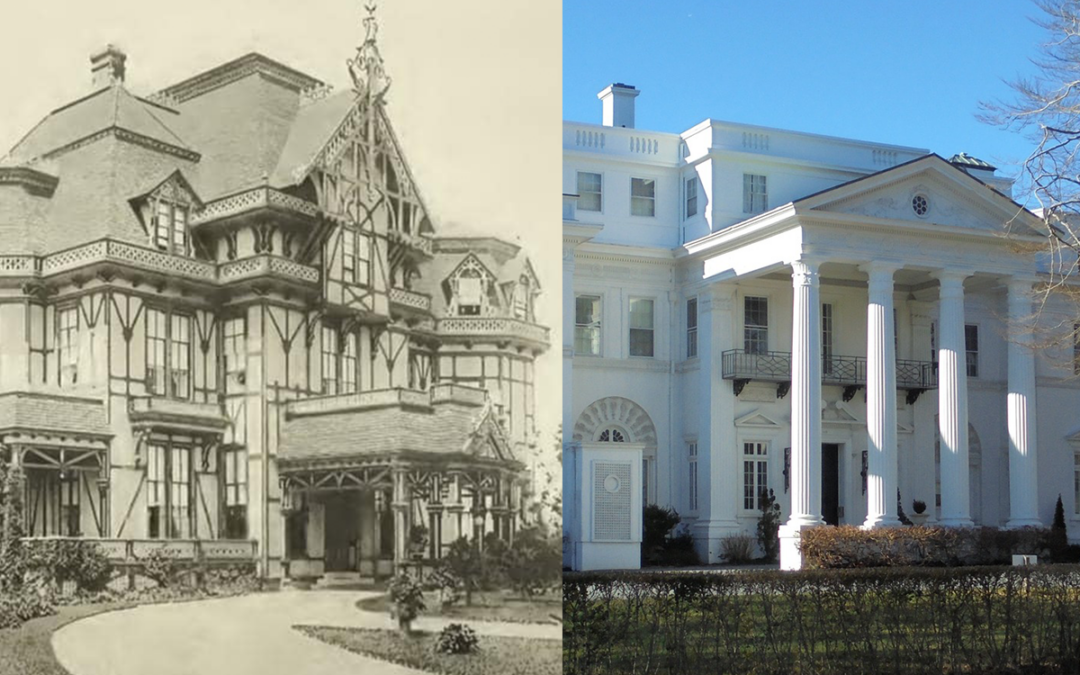
Edward Willing House (Richard Morris Hunt, 1865) / Sherwood Lodge (Hoppin & Ely, c.1906)
Many of the mansions of Newport have undergone major renovations as the owners’ needs (and the styles of the times) have changed. Previous A4 Archi-TEXT articles have touched on the renovations of Kingscote, Chateau-Sur-Mer, and Cliff Lawn, but perhaps one of the most dramatic transformations was that of the Sherwood Lodge, from a Stick Style building into a neo-Classical Mansion (and then its later conversion into a condominium).
The Original Structure: A Stick Style Sanctuary

Loring Andrews Residence (Galt & Hoy birds eye, c.1878)
Following the completion of the American Civil War in 1865, Newport increasingly became THE summer enclave for the Gilded Age elite. Early on, they preferred the informal, picturesque charm of Stick Style architecture. The original structure built for Edward Willing by Richard Morris Hunt was originally constructed in this vein—a wooden residence characterized by exposed decorative framing, steep gables, and an ornate Tudor-influenced exterior that celebrated the craftsmanship of American timber construction. This was typical of buildings like other early designs of Richard Morris Hunt like the J.N.A Griswold House, Chastelux, and their South Bellevue Avenue cousin known today as Le Chalet.

Edward Willing House by Richard Morris Hunt (before 1878)
In this era, the grammar of the building was one of verticality, material texture, and expressed structure. The “sticks” on the outside were not structural but served as a visual map of the wall framing underneath. It was a style that was evocative of summer leisure and relaxed living, perfectly suited for the mid-Victorian sensibility that valued ornate character over rigid symmetry. When Loring Andrews bought the house around 1870, he engaged George Champlin Mason to expand the structure, but maintained and elaborated on the earlier Stick Style. The house again changed hands to Theodore Havemeyer in 1880 and he engaged J.D Johnston to further expand and modernize the structure in the Stick Style in 1888, and the house given the name “Friedheim.”

Freidheim (Theodore Havemeyer Residence) by J.D Johnston (c. 1890)
The Pembroke Jones Era: From Timber to Temple
The most radical shift in the house’s history occurred when it was purchased by Pembroke Jones, a wealthy North Carolina rice merchant known for his lavish “shooting parties” and social prominence. By the turn of the century, the Stick Style was viewed as cluttered and dated. The architectural clients of the later Gilded Age demanded the pomp and formal European gravitas of the Neo-Classical and Italianate palaces like Marble House, The Breakers, Rosecliff, and The Elms.

Sherwood Lodge (Pembroke Jones Residence) by Hoppin & Ely (c. 1906)
Jones commissioned the architectural firm Hoppin & Ely to perform what can only be described as a total architectural metamorphosis. They stripped away the wooden “sticks” and gables, effectively erasing the house’s Victorian character. In its place, they wrapped the structure in a skin of white stucco and added a monumental, symmetrical facade.
Additionally, a large independent ballroom was constructed for entertaining guests at formal private parties, as became the custom after the purchase of Beechwood by Mr. and Mrs. William Backhouse Astor Junior in 1880. This element of the renovated house remains one of the dominant architectural features of the building as it exists today. To celebrate the transformation of the structure, Jones renamed it “Sherwood Lodge.”
–Massing: The irregular, rambling footprint was squared off to make the façade more symmetrical.
–Architectural Vocabulary: Massive Corinthian columns and a formal balustrade were added to the roofline to give the structure Classical character
–The Result: The house was transformed from a quirky, wooden retreat into a formidable, white-columned palazzo that looked as though it had been transported from the Italian countryside.
The Modern Chapter: Adaptive Reuse as Condominiums
As the 20th century progressed, the era of the single-family “super-mansion” came to a close. The sheer volume of Sherwood, which once required a staff of dozens and endless owner and guest suites, became an unaffordable burden. Following the trend of many of its neighbors, the estate underwent yet another great transformation: adaptive reuse into luxury condominiums.

Front Aerial of Sherwood Condominium (c. 2025)
This conversion required many clever internal shifts. The architects had to divide the grand, sweeping interior volumes into self-contained residences without destroying the historic exterior envelope. This preserved the grand Neo-Classical facade for the public while creating modern, efficient living spaces for multiple owners. The grand ballroom was converted into its own distinct luxury condominium unit.
Today, Sherwood stands on Bellevue Avenue as a silent witness to Newport’s shifting tastes. It proves that in architecture, the evolution of style in the City-by-the-Sea is never truly finished; it is simply edited, expanded and reappropriated or transformed for the next generation, with the help of talented and creative architects.

Sherwood Condominium, Ballroom Interior (c. 2024)
A4 Architecture has been pleased to assist many owners in a consulting capacity for both their minor and major renovations. If you have a New England building project in mind where quality and fine design are critical, please reach out to the award-winning professionals at A4 Architecture to assist you in realizing your architectural dreams. We look forward to hearing from and working with you.
Ross Cann, RA, AIA, LEED AP, is an author, historian, and is the founding Principal of A4 Architecture located in Newport, RI. He holds honor degrees in Architecture and Architectural History from Yale, Cambridge, and Columbia Universities and has taught architectural history in a variety of settings for nearly thirty years.