In New England, particularly in Newport, Rhode Island, many houses are designed in the
Shingle Style. This style utilized split cedar shingles, which were abundant in New England, to provide sidewall coverage to houses starting in the
Colonial Era up until today. There are many methods he finish shingles and each method offers distinct benefits and drawbacks, resulting in unique visual qualities for the finished structure.
The Natural Approach: Weathering and Aging

Partially Weathered White Cedar (Newport Casino, 1880)
The most traditional approach is to leave the cedar shingles unfinished, allowing them to age naturally. Initially, Alaskan Yellow and Eastern White Cedar have a blonde hue that gradually fades to a silvery-gray over a period of 10 to 15 years, particularly in salt air. Western Red Cedar, which has a warm, reddish-brown color initially, will age to a darker brown color over a decade. This process, known as
patination, is highly sought after for its rustic, timeless aesthetic. One main advantage of this approach is its low initial cost and minimal maintenance. Additionally, there is no need for periodic refinishing. However, without a protective coating, the wood is more susceptible to moisture, UV damage, and mildew, which can lead to warping, cracking, and rot over time. This can shorten the lifespan of the shingles, making them a less durable option in harsh climates. Providing a proper drainage plane behind the shingles will help extend the shingles’ utility, often doubling their life to 40 or 50 years.

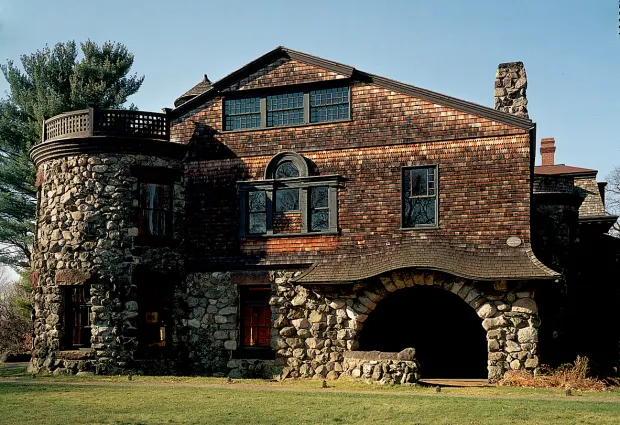
Fully Weathered White Cedar (Isaac Bell House 1882, Newport, RI)
Preserving Shingle Character: Bleaching Oil
For those who desire the natural gray look without the wait, bleaching oil is an excellent option. This finish accelerates the natural weathering process, giving new shingles an aged, silvery-gray appearance in just a few months. The primary advantage of this approach is achieving the desired aesthetic quickly while also providing some protection against UV rays and moisture. It allows the wood’s grain to remain visible, offering for a more natural look than paint or stain. The main disadvantage is that bleaching oil is not a long-term protective finish. It wears off over time and requires reapplication every 3 to 5 years to maintain its color and protective qualities, adding slightly to long-term maintenance costs.

Fully Weathered White Cedar with Bleach Oil (Private Residence by A4 Architecture, Newport, RI)
Enhancing and Protecting: Stains

Stained Shingles (Private Residence, Newport, RI)
Stains offer a versatile middle ground, providing both color and protection. They are available in various opacities, from transparent to solid. Transparent and semi-transparent stains allow the natural wood grain to show through while adding color, while solid stains provide a more uniform, painted look. The pros include excellent UV and moisture protection, which significantly extends the life of the shingles. Stains are also relatively easy to apply and reapply. The downside is the need for regular maintenance, typically every 5 to 7 years for transparent stains and 10 to 12 years for solid stains, to prevent fading and peeling. This adds a recurring cost and labor commitment. the other problem is changing colors can be extremely challenging.
Total Coverage and Durability: Paint
Failing Painted Shingles
Paint provides the most complete coverage and a wide range of color options. It forms a thick, protective film over the wood, shielding it from moisture, sunlight, and insects. The primary advantage is its superior protection and long-lasting finish, which can last for 10 years or more. Paint also allows for a uniform and clean aesthetic that complements modern, architectural styles. However, the disadvantages of this approach are considerable. Paint can trap moisture beneath the surface, leading to blistering and peeling if not applied correctly or if the wood is not properly dry. The very resin that makes cedar a natural repellent of water also makes it repel paint as well. Once the paint begins to fail, stripping it from textured shingles is a difficult and expensive process. It also completely hides the natural grain of the wood, which can be seen as a loss of the material’s inherent character and beauty.
If you aspire to create a beautiful Shingle Style home in New England, A4 Architecture has a vast amount of experience to help you achieve your goal, and we look forward to learning more about your project goals and dreams.
Ross Sinclair Cann, AIA, LEED AP, is an author, historian, educator, and practicing architect at A4 Architecture who lives and works in Newport, Rhode Island. He studied with Professor Scully as an undergraduate at Yale and was a teaching assistant for Robert A.M. Stern at the Columbia School of Architecture in New York. He has worked on dozens of buildings by McKim Mead and White, Peabody and Sterns, and other noted architects of the Gilded Age and has frequently designed renovations and new buildings in the Queen Anne Revival and Shingle Styles.